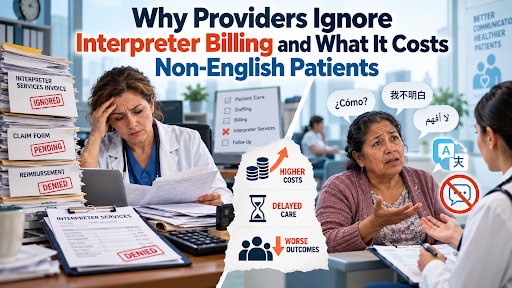
Walk into a busy clinic and observe how interpreting is managed. A medical assistant (MA) pulls away from her task to interpret in Spanish. A 15-year-old misses school to accompany an interpreter to help explain his grandmother’s symptoms. An appointment is cancelled to make room for an interpreter to arrive, set up a phone on a stand, and push a button to ‘connect’ to an online interpreting service. The need for interpreting is numerous and continuous. Rarely is billing done for interpreting services. All practices know they should look at their interpreter billing and rarely do.
The Rule Is Clear, the Payment Isn’t
There are approximately 25 million people in the US who have limited English proficiency. Title VI of the Civil Rights Act and Section 1557 of the Affordable Care Act state that facilities that accept Medicare and Medicaid funds must provide language assistance services at no cost to the patient. Many smaller practices have no funding but are still bound by law to provide the service.
Who pays for it? Medicare does not provide reimbursement for interpreter services. Many state Medicaid agencies do provide reimbursement (under HCPCS code T1013) for interpreter services; however, commercial payers do not reimburse for the service. Therefore, a practice may be legally required to provide a service for which they are not reimbursed. Most of what goes wrong in healthcare starts with that gap.
Why Providers Let the Claim Go
No one purposely ignores interpreter billing, but it usually doesn’t get done due to a combination of small decisions made throughout the day.
For starters, the rules are not clearly posted. They vary by state, plan, and contract. A front desk that cannot get a clear answer will not bill interpreters, as a claim that is not sent cannot be denied. Many practices do not have the time to figure out which payers pay, what code they want, and what modifier to use.
There is also the issue of completing the required paperwork for a payer that is going to reimburse the practice. The provider has to remember to write down the details of the interpreting service, like the length of the call, how it was interpreted (phone or video), and the name of the interpreter. If the provider doesn’t capture these details, the claim is denied.
Most practices aren’t getting reimbursed for interpreter services anyway, because a low reimbursement amount is not worth the risk of denial and additional work for the biller.
Finally, many people think that because a patient can’t be billed, no one can be billed. So the cost is absorbed as overhead, and over time practices cut back on interpreting services.
What Non-English Patients End Up Paying
Interpreter services get rationed first. Patients feel it the most. Services that cannot charge practices for interpreter services provide less. These forces staff to rely on family members, who may not know the medical terms, may soften the message or entirely omit information, or leave things out that the patient may not wish to say in front of them. Employees with some language skills may provide inadequate services, and no one can check on the quality of the interpretation.
There are numerous studies documenting negative events associated with language barriers. These include, but are not limited to, medication errors, missed follow-up visits, unplanned and repeat visits, adverse events, and inability to obtain truly informed consent. These result in increased avoidable readmissions, unnecessary testing, and malpractice exposure. Not submitting the claim does not change the cost, and shifting it to other payers does not make it disappear.
Trust also takes a hit. A patient who has to have a family member explain a diagnosis will not likely come back to the practice and this leads to later, more serious, diagnosis. All of this ultimately negatively impacts the patient and the practice.
Making Medical Interpreter Billing Work
Most of the fix is routine work. Practices that get medical interpreter billing right usually begin by finding out where reimbursement exists at all. Check your state Medicaid policy. Read commercial contracts line by line instead of assuming the answer is no. Where a payer does cover it, build the documentation into the visit note itself, with required fields for interpreter name, language, mode, and duration. That is usually enough.
Where no one pays for interpreter services, track the spend. Logging interpreter hours helps build a case for negotiating contracts and/or grants, or helping to demonstrate to leadership what language access truly costs. Additionally, logging interpreter hours can assist in justifying your organization’s compliance with regulatory requirements (i.e., an audit).
Coding plays a role as well. While the time may not be separately payable, it helps shape the documentation of the visit. A coder who has a full understanding of the visit can shape the documentation as such.
If your team can’t take this on, a partner who already knows the payer policies can handle verification and follow-up for you, such as the team at doctormgt.com.
The Bottom Line
Providers don’t skip interpreter billing because they don’t care about their patients. The rules are scattered, the paperwork is easy to miss, and the amounts look small next to the effort. But the cost of skipping it lands on patients who already have the hardest time getting care. Treating language access as something you document, track, and bill wherever you can is better for the practice and for the person sitting across from the interpreter.